
Destinations
The Best Golf Courses in Mexico
Where to play across Mexico’s top regions, from resort-heavy coastlines to lesser-known inland courses.
Destinations
Where to play across Mexico’s top regions, from resort-heavy coastlines to lesser-known inland courses.
Mexico's golf scene operates in two modes. There's the resort corridor (Los Cabos, Riviera Maya, Puerto Vallarta), where courses are bundled with hotels and the golf is part of a larger vacation package. And there's the standalone stuff, courses built on terrain so good that the golf justifies the trip on its own. Both modes produce excellent rounds, and the best trips combine them.
The country has over 200 courses, concentrated in a few key regions. Here are the ones worth building a trip around.
The Cabo corridor (San Jose del Cabo to Cabo San Lucas, connected by a 20-mile stretch of resort development) is the densest concentration of high-end golf in Mexico. The landscape is desert-meets-ocean, with the Sierra de la Laguna mountains rising behind and the Sea of Cortez stretching east. Nearly every course here has ocean views, and the combination of zero rainfall (it essentially never rains from November through May) and resort-grade maintenance produces conditioning that's hard to fault.
Diamante (Dunes Course) is a Davis Love III design that's become the consensus pick for the best course in Mexico. The routing moves through massive sand dunes on the Pacific coast, with holes that feel more like links golf than desert golf. There's no forced-carry target golf here; the ground game works, the bounces are true, and the variety of hole shapes is exceptional. The Tiger Woods-designed El Cardonal Course is the other 18 at Diamante, taking a different approach with more tree-lined holes and less dune exposure. Both are private, but resort access is available through select booking channels.
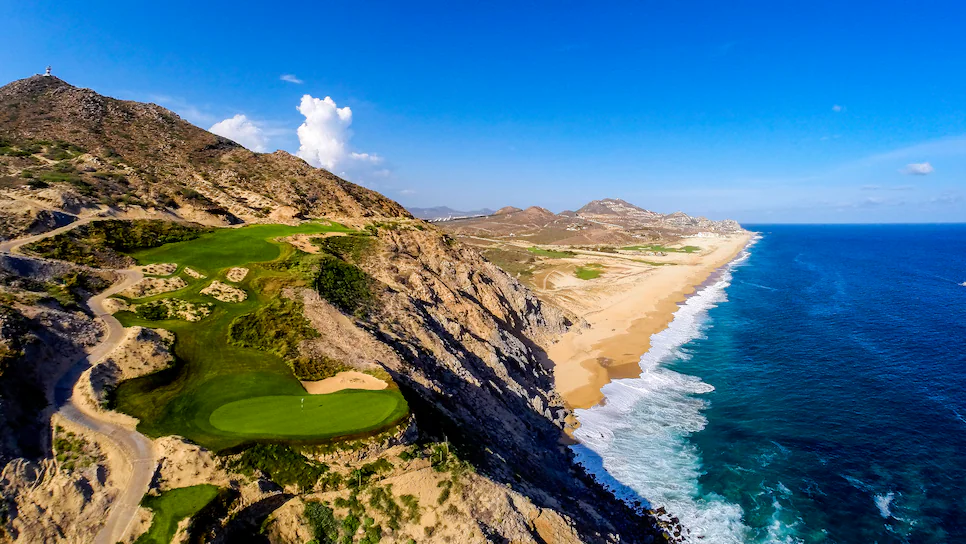
Quivira Golf Club occupies one of the most dramatic sites in Mexican golf: a stretch of coastline near Land's End where granite cliffs drop into the Pacific. Jack Nicklaus designed it, and several holes play along or across cliff edges with 200-foot drops to the ocean. The 5th hole (a par 3 from an elevated tee to a green perched on a cliff) and the 13th (a par 3 directly above the sea) are among the most photographed holes in the country. The course is part of the Pueblo Bonito resort complex.
Cabo del Sol (Ocean Course) was Tom Weiskopf's first Mexico design, and the stretch of holes along the Sea of Cortez (particularly the par-3 17th, playing across a cove to a cliffside green) is the signature sequence. The Desert Course (Norman design) offers a second round with more inland character.
Club Campestre San Jose is a Nicklaus design in the San Jose del Cabo area that plays through desert arroyos with the Sierra de la Laguna as a backdrop. Less ocean than the coastal courses, but the interior desert landscape has its own appeal, and the design rewards strategy over power.
The Banderas Bay region, stretching from Puerto Vallarta north through the Riviera Nayarit, combines Pacific coast scenery with Sierra Madre jungle in a way that no other golf destination in Mexico can match. The courses here play through different terrain than Cabo's desert: tropical vegetation, mountain backdrops, and ocean on the western edge.
Pacifico at Four Seasons Resort Punta Mita is a Nicklaus design on a private peninsula at the northern end of Banderas Bay. The course runs through tropical jungle along the coast, with the Tail of the Whale hole (3B) as its centerpiece: a par 3 playing 194 yards to a natural island green in the Pacific Ocean, accessible only at low tide. When the tide is up, you play an alternate green on the mainland. It's the only natural island green in golf. The rest of the course is strong throughout, with several holes playing along the beach and the back nine climbing to elevated tees with panoramic ocean views. Humpback whales are visible from the course from December through March.
Bahia at Four Seasons Resort Punta Mita is the second Nicklaus course on the same property, opened in 2008. It takes a different routing philosophy: more inland holes through the jungle, with the ocean appearing on the front nine and the Sierra Madre mountains framing the back. The 2 courses together offer 36 holes of Nicklaus design in a single location, which is unusual for Mexico.
Vista Vallarta (Nicklaus Course) sits in the hills above Puerto Vallarta with views across Banderas Bay. The Nicklaus design uses the elevation and the jungle terrain to create a course that feels remote despite being 15 minutes from PV's hotel zone. The Tom Weiskopf Course at the same facility is the other 18 and offers a slightly different character (more open, more wind-exposed on the upper holes).
El Tigre at Paradise Village is the best value on the Nayarit coast. A Von Hagge design that plays through a mix of jungle and lagoon, with crocodiles occasionally visible in the water hazards (they're real, they're large, and they're uninterested in you). Green fees are a fraction of the Punta Mita courses, and the design is fun, playable, and surprisingly strategic.
The Caribbean side of Mexico has fewer marquee golf courses than the Pacific, partly because the terrain is flat limestone (no dramatic elevation changes) and partly because the resort development model here favors beach and all-inclusive over golf-specific travel. But there are standouts.
El Camaleon at Mayakoba hosts the PGA Tour's World Wide Technology Championship (formerly the Mayakoba Golf Classic), making it the only course in Mexico on the regular Tour schedule. Greg Norman's design routes through 3 distinct ecosystems: mangrove, jungle, and coastline. The conditioning for the tournament is exceptional, and even outside tournament windows, the course is maintained to a high standard. Access is through the Mayakoba resort complex (Fairmont, Banyan Tree, and Andaz are among the properties on site).
Playa Mujeres Golf Club is north of Cancun and is one of the better resort courses on the Caribbean side. A Greg Norman signature design on a flat site, using water, bunkers, and mangroves to create interest. The ocean views from the back nine are the highlight.
Puerto Cancun Golf Club is a Tom Weiskopf design within the Puerto Cancun development, 10 minutes from the Cancun hotel zone. The course wraps around a mangrove preserve with the lagoon on one side and the Caribbean visible from the higher points. It's the most convenient course for anyone staying in Cancun.
Golf at altitude. Mexico City sits at 2,240 meters (7,350 feet), which means your ball goes 10-12% further than at sea level. Adjust accordingly or spend the round overshooting greens.
Club de Golf Mexico in Tlalpan (southern CDMX) is a Percy Clifford design from the 1940s that's hosted the World Cup, the Mexican Open, and the WGC-Mexico Championship. The course runs through a hardened lava field (the Pedregal) with volcanic rock formations lining the fairways. It's unlike any other course in the country. Private, but visitor access is possible with a member introduction.
Club de Golf Chapultepec hosted the WGC-Mexico Championship from 2017 to 2020 before the event moved. The course plays through the Chapultepec area with mature trees, elevation changes, and the kind of conditioning that comes from preparing for tour events. Also private with limited visitor access.
For visiting golfers without club connections, the Club de Golf Bosques and Club de Golf Bellavista in the CDMX area offer guest access and solid designs at elevation.
Tangolunda Golf Course in Huatulco is the southernmost notable course in Mexico. It sits within the Bahias de Huatulco national park, with holes running along the bay and through tropical forest. The setting is spectacular (howler monkeys in the trees, ocean on 3 sides), the design is modest, and the green fee is low. It's not a destination course, but if you're in Huatulco for the beach, it's a strong bonus round.
The best golf trip in Mexico picks 2 regions and commits to each for 3-4 days. Cabo and Nayarit are the strongest pairing: desert golf and jungle golf, Pacific on both sides, and enough course variety between the two to fill a week without repeating a layout.