Destinations
The Best Golf Courses in the American Southwest
A guide to the top desert golf destinations, from Scottsdale to Palm Springs and beyond.
Destinations
A guide to the top desert golf destinations, from Scottsdale to Palm Springs and beyond.
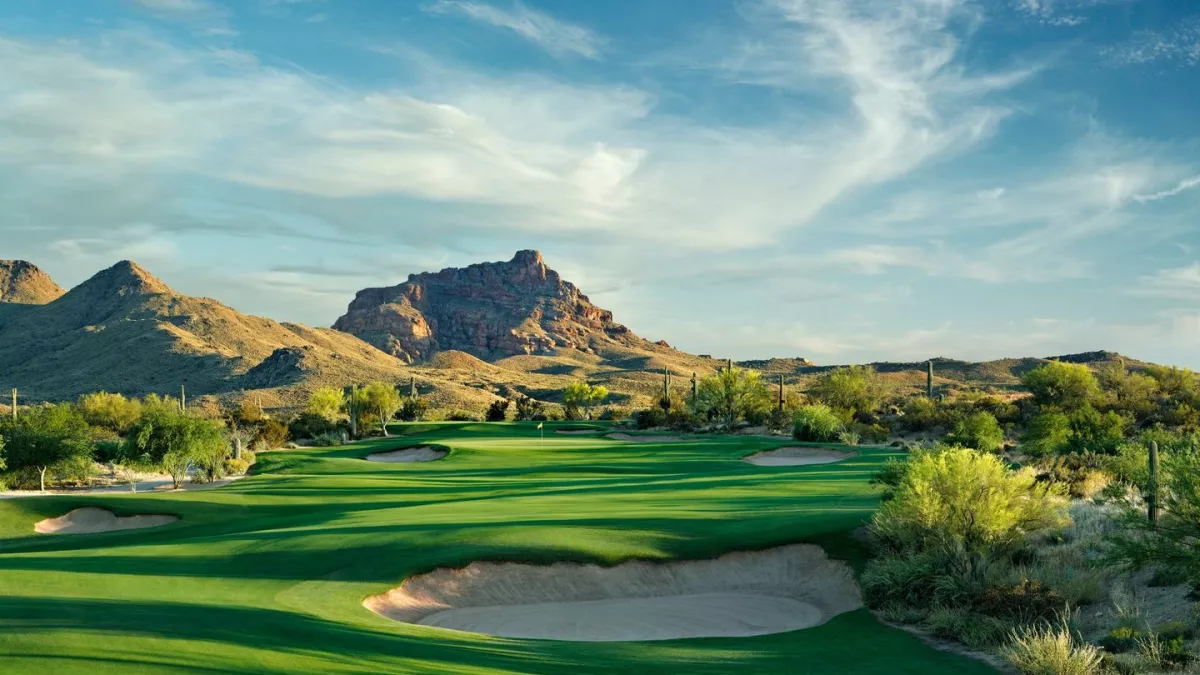
The American Southwest has one thing going for it that the traditional golf destinations (Pinehurst, Pebble Beach, Bandon) can't match: you can play 12 months a year. When courses in the Midwest and Northeast are frozen and courses in the Southeast are overseeded and squishy, the desert is dry, firm, and 22°C in January. Add the visual drama of red rock, saguaro cacti, and mountain backdrops, and you get some of the most distinctive golf landscapes in the country.
Here's what's worth playing across Arizona, New Mexico, and the Palm Springs area of California.
The Phoenix-Scottsdale metro area has over 200 golf courses. That's not a typo. The density is unmatched in the US, and the range covers everything from $50 municipal courses to $500 private club guest rounds. The challenge isn't finding golf; it's filtering.
We-Ko-Pa (Saguaro Course) is the best public course in Arizona and routinely ranks in the US top 50 public courses. Bill Coore and Ben Crenshaw designed it on the Fort McDowell Yavapai Nation land, and the routing flows through Sonoran Desert terrain with saguaro cacti, mesquite, and the Four Peaks mountains as a backdrop. The course has zero homes or development on it, which is rare for a Scottsdale course and a major part of its appeal. The Cholla Course (Scott Miller design) at the same facility is also excellent and slightly less expensive. Green fees for the Saguaro: $175-275 depending on season.
Troon North (Monument Course) was one of the original "desert target golf" courses when Tom Weiskopf designed it in 1990, and it still holds up. The Monument Rock (a 20-foot boulder sitting in the middle of the course) is the visual signature, but the design quality goes deeper: strategic angles, green complexes that demand approach-shot precision, and a routing that never feels like two consecutive holes play the same way. The Pinnacle Course is the second option at the same facility. Green fees: $200-325 in season.
Grayhawk (Raptor Course) hosts the PGA Tour's WM Phoenix Open's Monday qualifier and is one of the most popular courses in the Scottsdale corridor. Tom Fazio's design is more forgiving than Troon North or We-Ko-Pa, with wider fairways and more bail-out options, which makes it a good option for mid-to-high handicappers who don't want to lose a dozen balls in the desert. The Talon Course (David Graham and Gary Panks) is the other 18 at the same complex. Green fees: $150-275.
TPC Scottsdale (Stadium Course) is worth playing for the "I played where the Phoenix Open happens" factor, especially if you time it within a few weeks of the tournament when the course is still in event condition. The 16th hole (the famous party hole during the tournament, with grandstands that seat 20,000) is just a normal par 3 the rest of the year, which is its own kind of surreal. Green fees: $200-350.
Quintero Golf Club is 45 minutes northwest of Phoenix in the Hieroglyphic Mountains, and it's the course that Arizona golf insiders name when you ask them where to play. Rees Jones designed it through a canyon system with elevation changes of 200+ feet, dry washes cutting across fairways, and mountain views from every tee. It's further from the Scottsdale hotel corridor, which keeps it less crowded. Green fees: $100-200.
Tucson is an hour and a half south of Phoenix, cheaper, less crowded, and surrounded by a different (more dramatic) desert landscape: the Sonoran Desert here includes the Rincon Mountains, Sabino Canyon, and Saguaro National Park.
Ventana Canyon (Mountain Course) is the Tucson course that shows up in every "most scenic" list. Tom Fazio routed it through a natural canyon with 100-foot saguaro cacti lining the fairways and the Catalina Mountains filling the sky behind every green. The signature hole is the par-3 3rd, which plays 107 yards over a canyon to a green backed by the mountains. The green fee includes a cart, which you'll need; the terrain is hilly enough that walking it would be a hike.
Sewailo Golf Club at the Casino del Sol is a newer entry in the Tucson market (Notah Begay III designed it, opened 2013) and offers tournament-caliber conditioning at a green fee that undercuts most of the resort courses. It's flat by Tucson standards, but the design uses water features and bunkering creatively, and the practice facility is one of the best in the state.
Arizona National sits in the foothills of the Catalinas and plays along the edge of Sabino Canyon. Robert Trent Jones Jr.'s routing uses the natural topography to create strategic decisions on nearly every hole: drive it over the arroyo or lay back and play for position. The canyon views from the elevated tees on the back nine are worth the green fee alone.
Sedona is 2 hours north of Phoenix and the red rock scenery is some of the most visually striking landscape in the American West. The golf options are limited (it's a small town), but the setting is unmatched.
Seven Canyons is a private club with limited public access through certain booking platforms and stay-and-play packages with local hotels. Tom Weiskopf designed it among the red rock formations, and the course is built into the canyon landscape in a way that feels more like hiking with clubs than playing a typical desert course. If you can get on, go.
Sedona Golf Resort is the public option and it's better than most "public option in a famous scenic town" courses. The 10th hole, a par 3 that plays across a canyon with Cathedral Rock and Courthouse Butte framing the background, is the most photographed hole in Arizona (and it has steep competition). Green fees are $100-200. Call it a must-play for the setting, even if the design itself is straightforward.
The Coachella Valley stretches from Palm Springs to La Quinta and contains over 100 courses in a 30-mile corridor. The landscape is flat desert surrounded by mountains (the San Jacinto range rises 10,000 feet above the valley floor), and the golf culture is mid-century resort at its core: cart paths, cocktails, and conditions.
PGA West (Stadium Course) was designed by Pete Dye in his most diabolical mode. Deep pot bunkers, railroad ties, island greens, and a design philosophy that seems to enjoy punishing wayward shots. The 17th (an island-green par 3, called "Alcatraz") and the 16th (a par 5 called "San Andreas Fault" with a crevice splitting the fairway) are among the most dramatic holes in the desert. The other courses at PGA West (Nicklaus Tournament, Dye Dunes, Dye Mountain) are also open to resort guests. Green fees: $150-300.
Indian Wells Golf Resort (Players Course) is a John Fought design that's consistently ranked among the best resort courses in California. Mountain views from every hole, generous fairways, and conditioning that's always strong. The Celebrity Course (Clive Clark design) is the other 18 on the property. Green fees: $75-175. Best value in the Coachella Valley for quality-per-dollar.
The Classic Club in Palm Desert hosted the Bob Hope Chrysler Classic (now the American Express) and is one of the better public options in the valley. Arnold Palmer's design uses the mountain backdrop effectively, and the course is long enough to host tour events but playable enough from the forward tees for recreational golfers. Green fees: $75-150.
New Mexico is the most underrated golf state in the Southwest. The altitude (most courses sit above 5,000 feet) gives you extra distance, the mountain scenery rivals anything in Arizona, and the courses are dramatically cheaper.
Black Mesa is 30 minutes north of Santa Fe on the Pojoaque Pueblo and is the best course in the state by a significant margin. Baxter Spann designed it through high desert terrain with juniper, sage, and the Sangre de Cristo Mountains as a backdrop. The course climbs and drops with the natural topography, and the 8th hole (a par 4 playing from an elevated tee down to a fairway framed by black volcanic mesas) is the most dramatic hole in New Mexico golf. Green fees: $50-80. At that price, it's arguably the best value in Southwest golf.
Paa-Ko Ridge is 30 minutes east of Albuquerque in the Sandia Mountains. 27 holes at 7,000 feet elevation, with ponderosa pines, juniper, and mountain views in every direction. Ken Dye designed it, and the conditioning is strong for a public course in a state that's not known for manicured fairways. Green fees: $60-100.
University of New Mexico Championship Course in Albuquerque is a Red Lawrence design that consistently ranks as one of the best municipal courses in the US. 7,248 yards from the tips, hosting the college championships regularly, and green fees under $60. The course is excellent, the price is absurd, and the altitude means your 7-iron goes 160 instead of 150.
October through April is peak season in Arizona and Palm Springs. December through February is prime time: warm (18-24°C), dry, and the courses are in peak condition. This is also when green fees and hotel rates peak.
Shoulder months (October, November, March, April) offer lower rates and slightly warmer temps. April in Scottsdale can hit 32°C, which is manageable with an early tee time.
May through September is brutally hot in the low desert (40°C+ in Phoenix and Palm Springs). Green fees drop 50-70%, and some courses offer rates under $50. The early morning rounds (6am tee time, finished by 10:30am) are playable. Anything after noon is dangerous.
New Mexico plays on a different calendar because of the altitude. Summer is the best season (20-28°C at elevation), while winter brings occasional snow to the higher courses.