Destinations
The Best Golf Resorts in the Caribbean
A complete guide to the top courses across the Caribbean, from iconic resort layouts to lesser-known island gems.
Destinations
A complete guide to the top courses across the Caribbean, from iconic resort layouts to lesser-known island gems.
Caribbean golf exists in a different category from mainland golf. The courses are almost always attached to resorts. The green fees are almost always high. The weather is almost always perfect (26-32°C, trade winds, sunshine), which means you're paying a premium for the setting and the guarantee that your round won't get rained out in November. Whether that premium is worth it depends on whether you see the golf as the point of the trip or a bonus alongside the beach, the food, and the rum.
Here's what's worth playing, island by island.
The DR has the most developed golf infrastructure in the Caribbean, with 3 major resort corridors and courses designed by the biggest names in the industry. The combination of quality, quantity, and (relative to other Caribbean islands) value makes it the default answer for golfers who want a Caribbean golf trip.
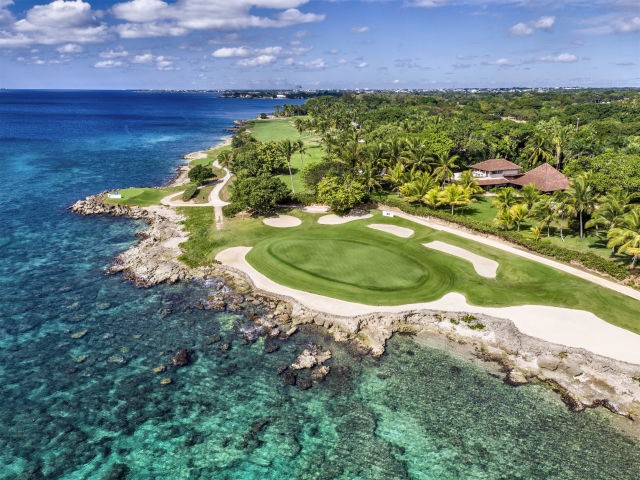
Teeth of the Dog at Casa de Campo (La Romana) is the most famous course in the Caribbean and one of the most famous resort courses in the world. Pete Dye designed it in 1971, and 7 of the 18 holes play along the Caribbean Sea on coral rock formations. The 5th and 7th holes (back-to-back par 3s over the ocean) are the signature, but the inland holes are strong enough that the course would be excellent even without the coastline. Casa de Campo has 2 additional courses: Dye Fore (27 holes above the Chavon River gorge, with 300-foot elevation drops) and The Links. Green fees for Teeth of the Dog: $350+ for non-resort guests; included in some stay-and-play packages.
Punta Espada at Cap Cana (Punta Cana) is a Jack Nicklaus design on the eastern tip of the island. 8 holes along the Caribbean coastline, with cliff-top tees, ocean carries, and the kind of visual drama that most Caribbean courses aspire to but few achieve. The conditioning is consistently among the best in the region. It's hosted the PGA Tour's Cap Cana Championship. Green fees: $350+.
Corales at Puntacana Resort & Club was designed by Tom Fazio and plays through a dramatic corridor of coral rock canyons and ocean frontage. The finishing stretch (holes 15-18 along the cliffs) is called the "Devil's Elbow" and includes a par 3 over the ocean that's as good as anything in the Dye playbook at Casa de Campo. The resort also has the P.B. Dye-designed La Cana course, which is solid if less spectacular.
Playa Dorada Golf Course (Puerto Plata) is the north coast value option. Robert Trent Jones Sr. designed it in the 1970s, and while it lacks the coastal drama of the Punta Cana courses, it's a good layout at a fraction of the price. Green fees: $100-150.
Jamaica has fewer courses than the DR, but the quality at the top is high, and the island's culture, cuisine, and vibe add a dimension that the resort corridors in Punta Cana don't always match.
The White Witch at Rose Hall (Montego Bay) plays along a mountainside above the Caribbean, with views that extend to the horizon from the elevated tees. The course is named after Annie Palmer, the legendary (and possibly fictional) mistress of Rose Hall Great House, whose property the course occupies. The routing uses over 600 feet of elevation change, which makes club selection an adventure and the cart ride an experience in itself. Green fees: $200-300.
Cinnamon Hill at Rose Hall is the other course in the Rose Hall complex and occupies a historic sugar plantation. It's flatter and more playable than the White Witch, with holes that run along the shore and through the plantation grounds. Johnny Cash owned a house on the property (it's visible from the 5th tee). The par-5 5th hole plays directly along the beach, with the Caribbean as an out-of-bounds hazard that's more tempting than intimidating.
Tryall Club (Montego Bay) is a private club that allows resort guest access. The course is set on a former sugar estate with views across Montego Bay, and the par-3 7th (downhill to a green beside the sea) is one of the most photographed holes in Caribbean golf. The property has a vintage, old-money Caribbean atmosphere that the newer resort developments don't capture.
Royal Westmoreland is the best course on the island and one of the stronger layouts in the eastern Caribbean. Robert Trent Jones Jr. designed it on the west coast, with views across to the ocean and well-maintained fairways that hold up year-round. It's part of a residential community, and green fees for visitors are available through select hotels and booking services.
Apes Hill Club is a newer addition to the Barbados golf scene, designed on a former sugar plantation at the island's highest point. The views from the elevated holes extend across the island, and the combination of altitude, trade winds, and well-designed green complexes makes it a more interesting test than its relative anonymity suggests.
TPC Dorado Beach (East Course) is a Robert Trent Jones Sr. design that was recently renovated and relaunched as a TPC property. It plays through coconut palms and tropical vegetation on the north coast, with a renovated layout that brings the original design into modern condition. The West Course is the second 18. As a US territory, Puerto Rico requires no passport for American travelers, which simplifies logistics.
Royal Isabela on the northwest coast is the most dramatic golf setting in Puerto Rico: a cliff-top course with holes that play along and over Atlantic Ocean bluffs. The course was designed by David Pfaff and Charlie Pasarell, and the routing uses the natural terrain with minimal earthmoving. The resort is small (20 casitas) and the experience is intimate. Green fees are included for guests.
Provo Golf Club is the only 18-hole course in Turks and Caicos, designed by Karl Litten on Providenciales. The course plays through limestone outcrops and native vegetation, with ocean views from several holes. It's well-maintained for a single-course island, and green fees are reasonable by Caribbean standards ($200-250). The island's beaches (Grace Bay, consistently rated among the best in the world) provide the non-golf incentive.
The Ocean Club Golf Course (Nassau) is a Tom Weiskopf redesign on Paradise Island, adjacent to the Atlantis resort. The course plays along the harbor and through manicured tropical landscaping. It's the most convenient golf option for visitors staying at Atlantis or in Nassau proper. Green fees: $250+.
The Abaco Club (Great Abaco Island) is a Scottish-style links course on a Caribbean island, which is as unusual as it sounds. Designed by a team that studied traditional links principles and applied them to a coastal site in the Bahamas, the result is a windswept, firm-and-fast layout that plays differently from every other Caribbean course. The club is private, but resort guest access is available.
Four Seasons Resort Nevis Golf Course is a Robert Trent Jones Jr. design that climbs the lower slopes of Nevis Peak, with the volcanic mountain rising above and the Caribbean Sea below. The elevation changes are dramatic (unusual for Caribbean golf), and the green complexes are well-designed for a resort course. Vervet monkeys are a regular presence on the course. Green fees are included for resort guests; outside play is sometimes available.
The courses here are expensive. A round at the top properties (Teeth of the Dog, Punta Espada, Royal Isabela) costs $300-400, which puts them in the same range as Pebble Beach or TPC Sawgrass. The difference is that you're also paying Caribbean resort rates for accommodation and flights, so the total trip cost is higher than a comparable golf trip to, say, the Algarve or Arizona.
The value proposition is the package, not the round. A Caribbean golf trip works when the golf is one part of a broader vacation (beach, food, snorkeling, doing nothing) and the setting of the course adds something that a mainland course can't. Playing a par 3 over coral cliffs into the Caribbean Sea while trade winds push your ball toward the water is a different experience from playing a par 3 over a pond in Orlando, even if the course design is comparable.
The weakest Caribbean golf trips are the ones where the golfer tries to play 36 holes a day in 30°C heat and wonders why they're exhausted by day 3. One round per day, with the afternoon reserved for the beach or the pool, is the rhythm that works. The golf here is the complement, not the main course.