Learn the Game
The Most Iconic Holes in Golf (and How to Play Them)
The world’s most memorable holes, why they matter, and how you can experience them yourself.
Learn the Game
The world’s most memorable holes, why they matter, and how you can experience them yourself.
Golf has a handful of holes that transcend the courses they belong to. Holes that show up in conversation, in photographs, in the mental catalog of anyone who's watched a major or cracked open a golf magazine in the last 50 years. Some are iconic because of what happened there. Some because of how they look. Some because they present a decision that reveals something about the kind of golfer you are.
Here are the ones worth knowing about, what makes them memorable, and (where applicable) how to actually get on and play them.
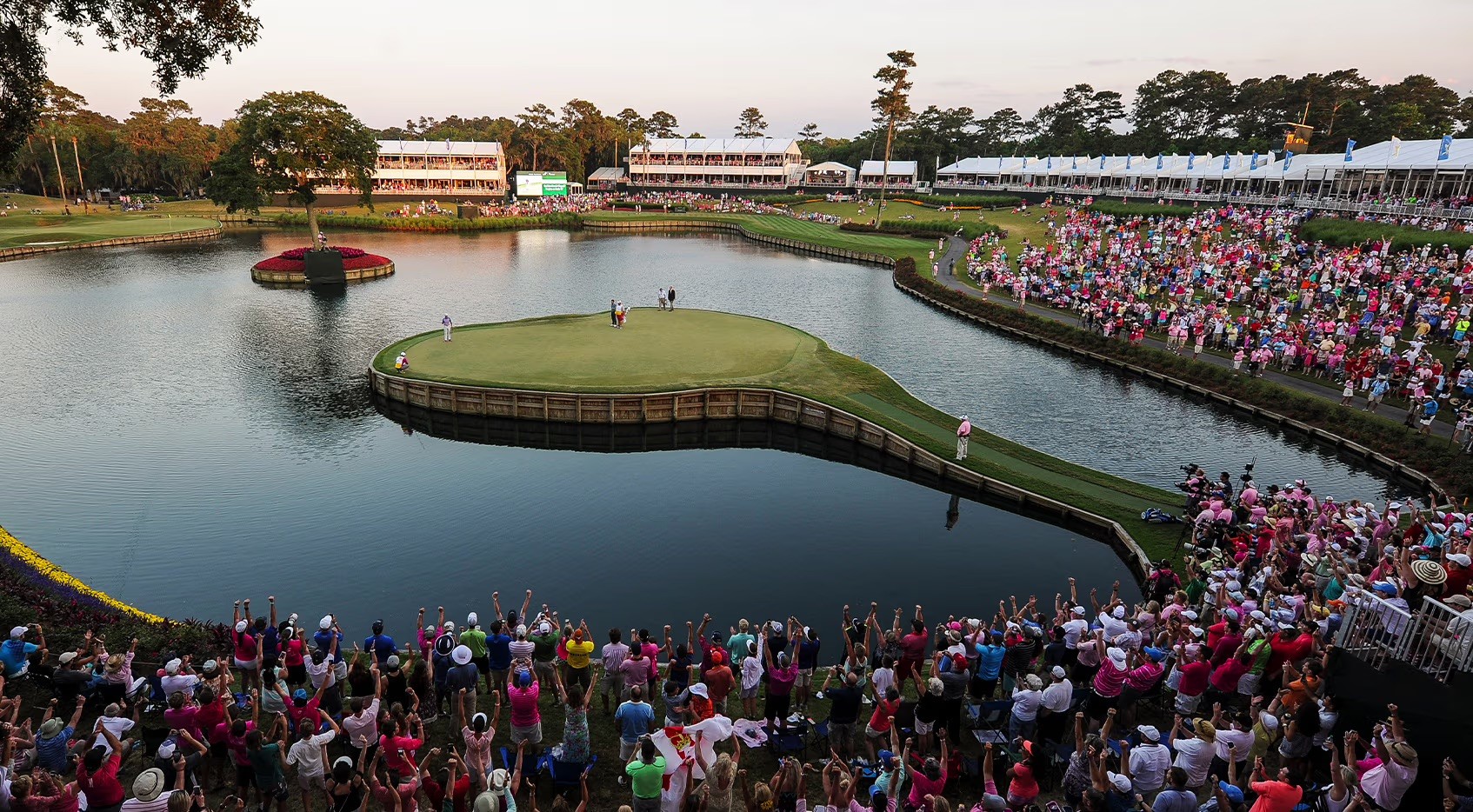
The most televised hole in golf. A par 3 playing 137 yards to an island green surrounded by water on all sides. During the Players Championship, roughly 100,000 balls find the water in a typical year. The hole is shorter than most par 3s and the green is bigger than it looks on television (78 feet deep), but the psychological pressure of no bailout makes club selection feel like a life decision.
How to play it: TPC Sawgrass is a resort course, meaning anyone can book a tee time by staying at the Sawgrass Marriott or booking through the resort. Green fees are premium ($400+ in season), but accessibility is straightforward. The course is in excellent condition year-round. Take one extra club. The water is closer than your brain thinks it is.
A 123-yard par 3 to an elevated green the size of a modest living room, surrounded by bunkers with names (the "Coffin" is the deep one front-left). Tiger Woods made a hole-in-one here during the 2016 Open. Gene Sarazen did it in the 1973 Open at age 71. The hole proves that distance is the least interesting variable in golf.
How to play it: Royal Troon offers visitor access on specific days. Check the club's booking calendar in advance. Green fees are in the £300+ range for the Old Course. The Portland Course (Troon's second layout) is cheaper and also open to visitors.
The most famous par 4 in golf. A blind tee shot over the corner of a hotel (the Old Course Hotel, with guests watching from the balconies). A long approach to a narrow green with the Road Hole Bunker guarding the left side and an actual road (and a stone wall) immediately behind the green. The bunker is 10 feet deep with a vertical face, and more professional golfers have taken 3 shots to get out of it on camera than anyone would like to admit. The hole rewards conservative play, but conservative play often leads to bogey anyway. It's a perfect hole.
How to play it: The Old Course operates a ballot system for visitor tee times. Enter online by 2pm the day before you want to play. Results come out by 4pm. Odds improve in shoulder season. Green fee: £340 in summer.
Not a single hole but a three-hole stretch that's decided more Masters tournaments than any other section of any course. The 11th (White Dogwood) is a 520-yard par 4 with a pond guarding the left side of the green where Larry Mize chipped in to beat Greg Norman in 1987. The 12th (Golden Bell) is a 155-yard par 3 over Rae's Creek with a green that's only 10 paces deep and a swirling wind that changes direction between club selection and backswing. The 13th (Azalea) is a 510-yard par 5 with a creek crossing the fairway and fronting the green, demanding a second-shot decision that separates the bold from the wise.
How to play it: You can't. Augusta National is a private club with no visitor access. But it belongs on this list because no conversation about iconic golf holes is complete without it. The closest you can get is watching the Masters in person (patron badges are awarded by lottery) or standing on Washington Road outside the gates and imagining.
The only natural island green in golf. A par 3 playing 194 yards to a green on a rock formation in the Pacific Ocean, accessible only at low tide via a natural land bridge. At high tide, you play an alternate green on the mainland. The hole was designed by Jack Nicklaus and exists because the rock formation happened to be there, sitting in the ocean at exactly the right distance from the tee. The tee shot carries entirely over ocean, with humpback whales visible during winter months (December through March). It's the kind of hole that doesn't look real in photographs.
How to play it: The Pacifico Course is part of Four Seasons Resort Punta Mita. Resort guests have access, and outside play is sometimes available through the resort's golf program. The Bahia Course (also Nicklaus-designed) is on the same property. Check tide charts before your round; the island green is only playable at certain times.
A 230-yard par 3 over the Pacific Ocean to a green perched on a rocky promontory with sea lions on the rocks below and the sound of waves crashing 100 feet beneath you. Many players lay up to a small fairway area short of the ocean crossing and play for bogey, because the penalty for going at the green and missing is a ball in the Pacific and a large number on the card.
How to play it: You almost certainly can't. Cypress Point is one of the most exclusive private clubs in the world, with approximately 250 members and no public access. Playing it requires a member invitation. If you get one, cancel whatever else you have planned that day.
The original Redan, a par 3 that's been copied at hundreds of courses around the world for over 100 years. The green sits at an angle to the tee, sloping from front-right to back-left, with a deep bunker guarding the left side. The design forces you to play away from the flag to use the slope, which is counterintuitive enough that it changed how architects thought about green design. Every Redan hole at every course in the world is a descendant of this one.
How to play it: North Berwick is a public links course 30 minutes from Edinburgh. Green fees are reasonable (£110-200 depending on season), and visitor access is good on most days. The course is short by modern standards but endlessly interesting. Play it with a caddie who knows the history.
The 14th at the Old Course (called "Long") is a 618-yard par 5 with Hell Bunker sitting in the middle of the fairway at about 340 yards from the tee. The bunker is enormous and deep enough that if you're in it, the top of the face is above your head. The Beardies (a cluster of smaller bunkers) sit on the left side at driving distance, funneling tee shots toward Hell. The strategy is simple to describe (avoid the bunkers) and maddeningly difficult to execute because the fairway narrows right where everyone's tee shot lands.
How to play it: Same ballot system as the 17th. Same course, same process.
A 543-yard par 5 that hugs the cliff edge of Carmel Bay for its entire length. The Pacific Ocean runs along the left side from tee to green, with rocks and surf below. The approach shot to the green, with waves crashing on the left and the famous lone cypress visible in the distance, has been the backdrop for some of the most memorable moments in major championship history (Tom Watson's chip-in at the 1982 US Open was on the 17th, one hole earlier, but the 18th is the one that closes the show).
How to play it: Pebble Beach is a public course. Anyone can book a tee time. Green fees are $625, which makes it the most expensive public round in the US and, many would argue, worth it. Book 60-90 days in advance for peak season.
A 261-yard par 3 over the Pacific Ocean from an elevated tee to a green set against black lava rock. Robert Trent Jones Sr. designed it, and when the resort owner said it was too hard, Jones stepped onto the tee, hit a hole-in-one, and reportedly said, "I think the hole is eminently fair." The story might be apocryphal. The hole is eminently dramatic.
How to play it: Mauna Kea Golf Course is part of the Mauna Kea Beach Hotel. Resort guests get priority, but outside play is available. Green fees are $225-300 depending on time of day and residency.
Golf courses have 18 holes, and most of them blend together in memory within a week. The ones on this list don't blend. They stick because they forced a decision (play safe or go for it), created a moment (the tee shot that has to carry the ocean), or provided a setting so unusual that it imprints regardless of how you played it.
The best hole on any course is the one that makes you feel something before you've taken the club back. These are those holes.