Destinations
What Nobody Tells You About Golf in Japan
An inside look at Japan’s unique golf culture, etiquette, and what to expect before you play.
Destinations
An inside look at Japan’s unique golf culture, etiquette, and what to expect before you play.
Japan has over 2,400 golf courses, the second-highest number in the world behind the United States. The game is woven into business culture, retirement culture, and weekend culture in ways that make it function differently from anywhere else on earth. The courses are immaculate. The etiquette is strict. The lunch break in the middle of the round is mandatory. And if you don't know how things work before you show up, you'll spend the first 3 holes confused and the next 15 trying to catch up.
Here's what you need to know.
Almost every course in Japan runs a split-round format. You play the front 9, return to the clubhouse for a sit-down lunch (typically 45-60 minutes), then play the back 9. This is not optional. It's built into the course schedule, and the tee times for the back 9 are assigned based on when each group finished the front.
The lunch is a full meal, not a hot dog from the cart. Most clubhouses have restaurants serving Japanese cuisine: tonkatsu, soba, curry rice, sashimi sets. Beer and highballs are available and socially acceptable during the break (the Japanese approach to alcohol on the golf course is more relaxed than the American one). The meal is typically included in the green fee or available for 1,500-3,000 yen ($10-20).
The break takes some getting used to if you're accustomed to the American model of powering through 18 straight. But once you stop fighting it, the lunch break makes the round better. You reset. You eat well. You play the back 9 fresher than you played the last 3 holes of the front.
Almost every golf clubhouse in Japan has a communal bath (ofuro or onsen). After your round, you're expected to use it. The baths are separated by gender, and you enter without swimwear (this is not negotiable). There are washing stations where you clean yourself thoroughly before entering the bath, which is for soaking, not cleaning.
For Western golfers, the communal nudity takes approximately 90 seconds to get over. After that, sitting in hot water overlooking a Japanese garden after 18 holes of golf is one of the best post-round experiences in the sport. The better clubs have multiple baths (indoor, outdoor, cold plunge), saunas, and grooming stations stocked with everything from razors to hair product.
Japanese golf etiquette is more formal than what you'll encounter in the US, UK, or Australia. Not oppressively so, but enough that knowing the basics prevents uncomfortable moments.
Dress code. Collared shirts and proper golf trousers or shorts (knee-length) are standard. Many clubs require a jacket in the clubhouse. Denim is prohibited at almost every course. Some clubs prohibit shorts on the course entirely. Check before you go.
Shoes. Change into your golf shoes in the locker room, not in the parking lot. Arriving in golf shoes is considered the equivalent of wearing a bathrobe to a restaurant. Most clubs have a bag drop where staff unload your clubs from the car. You walk in wearing regular shoes, change in the locker room, and walk to the first tee through the clubhouse.
Pace of play. Japanese golfers play slowly by international standards. A round of 18 (including the lunch break) takes 5-6 hours. Don't expect to play in 4 hours. The pace is deliberate, and rushing is considered disrespectful to the course and the group. If you're playing with Japanese golfers, match their tempo.
Divots and ball marks. Repairing divots and ball marks is taken extremely seriously. Courses provide sand bottles on every cart (for filling divots on the fairway) and expect them to be used on every shot. Leaving an unrepaired ball mark on the green would be noticed and silently judged.
Carts. Most courses in Japan use remote-controlled GPS carts that follow a track embedded in the cart path. You don't drive the cart. It drives itself between holes, and you walk from the cart path to your ball. Some courses offer walking, but carts are the default and usually mandatory.
Kawana Hotel Golf Course (Fuji Course) is on the Izu Peninsula, about 2.5 hours south of Tokyo. It's the most famous course in Japan, often called "the Pebble Beach of Japan" because of its clifftop setting overlooking Sagami Bay. Designed by Charles Alison in 1936, the Fuji Course climbs along the coast with holes that offer views of the ocean and (on clear days) Mt. Fuji in the distance. The course is part of the Kawana Hotel, and guests have priority. Green fees are premium by Japanese standards but reasonable by international ones.
Naruo Golf Club in Hyogo Prefecture is one of the oldest courses in Japan (founded 1904) and a regular host of professional events. The course is a classic parkland layout with mature trees and strong routing. Visitor access is limited; you may need an introduction from a member.
Kasumigaseki Country Club hosted the 2021 Olympic golf competition and is one of the most prestigious clubs in Japan. Two courses (East and West), both excellent. Access is extremely limited for non-members. If you have a connection, use it.
Hokkaido is Japan's northern island, and the golf season there (May through October) offers cool temperatures, dramatic landscapes, and courses that are less crowded than those near Tokyo or Osaka.
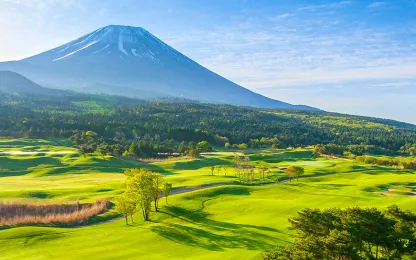
Niseko Village Golf Course is at the base of Mt. Yotei (Hokkaido's version of Mt. Fuji) and was designed by Arnold Palmer. The mountain backdrop from every hole is extraordinary. The same area is famous for skiing in winter, and the summer golf season attracts a fraction of the winter crowd. Green fees are reasonable.
North Country Golf Club near Chitose (close to Sapporo's airport) is one of the best-conditioned courses in Hokkaido. The routing runs through birch forests and rolling terrain, and the cooler climate means the fairways stay lush all summer.
PGM Golf Resort Okinawa sits on a ridge overlooking the East China Sea, with ocean views from most holes. The tropical setting (palm trees, warm air, blue water) makes it feel more like Hawaiian golf than mainland Japanese golf. The course is accessible and well-maintained, and the resort infrastructure makes it easy to combine with a beach vacation.
Golf in Japan is more expensive than most of Asia but comparable to premium courses in the US or UK. The total cost breaks down differently, though.
Green fee: 10,000-25,000 yen ($65-165) for a typical good course. Premium courses and weekends are higher. Budget courses exist at 5,000-8,000 yen.
Caddie fee: 3,000-5,000 yen ($20-35) per bag. Caddies are common at higher-end courses and sometimes mandatory. They carry your bag (carts carry the bags at some clubs), read greens, and know the course intimately. Tipping is not expected in Japan (this applies to all service, not just golf).
Cart fee: 500-1,000 yen ($3-7) in addition to the green fee at courses that use carts.
Tax and service charge: Japan adds consumption tax (10%) and sometimes a facility-use tax on golf. These are often not included in the quoted green fee.
Lunch: 1,500-3,000 yen ($10-20). Usually separate from the green fee.
A full day of golf at a good course (green fee + caddie + cart + lunch + tax) runs 18,000-35,000 yen ($120-230), which is competitive with a resort round in Arizona or a top public course in the UK.
GDO (Golf Digest Online) is the largest golf booking platform in Japan. The site is available in English (though the translation is imperfect), and it covers thousands of courses across the country. You can search by region, price, date, and course rating.
Direct contact. Some courses (especially the more exclusive ones) prefer phone or email bookings. Having a Japanese-speaking friend or your hotel concierge make the call significantly improves the experience.
Weekday vs. weekend. Weekend and holiday tee times are significantly more expensive (often 50-100% more) and book up faster. If your schedule allows, play weekdays.
English is spoken at the clubhouse desk and pro shop at the major courses and resort clubs. At smaller, local courses, English may be limited. Learn a few phrases: "tee time" works (it's the same in Japanese), "onegaishimasu" (please) goes a long way, and having your booking confirmation on your phone in both English and Japanese prevents confusion.
Google Translate's camera function is useful for reading menus in the clubhouse restaurant and signs around the facility.
Renting a car is the most flexible option. Japanese roads are excellent, navigation systems are available in English, and the expressway system connects major golf regions. Driving is on the left side. The tolls add up (expressway tolls from Tokyo to the Izu Peninsula can run 5,000+ yen each way).
Trains. Japan's rail system can get you close to many courses, but the "last mile" from the station to the course usually requires a taxi or a shuttle. Some courses offer shuttle service from the nearest station. Check when booking.
Club transport. A quirk of Japanese golf culture: you can ship your golf bag to the course in advance via Yamato Transport (the company with the black cat logo). Pack your bag, attach the shipping label, drop it at a convenience store or hotel front desk, and it arrives at the course the next day. The return works the same way. The cost is about 2,000-4,000 yen per bag each way. This is a genuinely useful service if you're traveling by train or don't want to deal with a golf bag in a Tokyo taxi.
Golf in Japan operates on a set of assumptions that are different from what Western golfers are used to. The pace is slower. The presentation is more formal. The lunch break is sacred. The bath afterward is essential. Once you stop comparing it to what you know and start experiencing it on its own terms, it's one of the best golf cultures in the world.